

An study on the best email to text services didn’t need to exist three years ago. It absolutely needs to exist now.
Because…
For the past two decades, email to SMS was included in your phone plan. Every major cell phone carrier offered it. Not everyone used it, but we all had it available it we wanted it.
That’s not true anymore.
Every cell phone carrier has gotten rid of email to text now, for a variety of reasons (which I’ll cover later). And no, obviously, your bill hasn’t gone down as a result.
So if you’re one of the millions of people who were relying on email to text to get important alerts, you need an alternative provider.
I’ve actually tried out all of the biggest names (and some of the smaller names too). After all, we here at GMass are experts on all-things email, and email to text certainly qualifies. So I had to know what’s what and now, I’m passing my findings along to you.
Here are the 9 best email to SMS services in 2026 so you can quickly and easily replace what you used to get from your cell carrier.
Best Email to Text Services: Table of Contents
- The Cell Carriers’ Email to Text Gateways Aren’t Coming Back
- The 9 Best Email to Text Providers
- Picking the Best Email to Text Provider in 2026
The Cell Carriers’ Email to Text Gateways Aren’t Coming Back
Before we jump into the list, there’s one foundational truth we need to get out of the way:
The cell phone carriers’ email to text gateways are dead (or on death row) and aren’t coming back.
T-Mobile’s tmomail.net stopped delivering in late 2024.
AT&T shut down txt.att.net in June 2025 and took Cricket and FirstNet with it.
Verizon’s vtext.com and vzwpix.com are currently in the process of winding down — meaning some messages are making it through and some aren’t — but they officially stop on March 31, 2027.
And no carrier has plans to bring them back one day. I even had a discussion with someone from AT&T who confirmed that. (I mean, we had the conversation in a Reddit thread, but yeah, still a conversation.)
Why they shut down
Sure, we can be cynical about why the carriers shut down email to text. (That is: Email to text cost them some money and wasn’t a prominent enough feature to make them money, so hey, cut the service but don’t cut the bill and it’s win-win. For them, not you.)
But the official reason really does have some merit behind it:
- The email to text services were absolutely abused by spammers.
- As a result, a new organization called The Campaign Registry was formed, which requires text senders to register themselves and their campaigns.
- That registration process was prohibitive for the cell carriers both logistically and financially, so they just killed their email to text services.
And now, in The Campaign Registry era, anyone sending a text from an application through a regular phone number needs to register in advance. It’s called A2P 10DLC.
There are initial and ongoing fees, there’s paperwork, and it’s a big, unpleasant surprise for anyone who thinks: “It’s 2026, I can get AI to build me an email to text app before lunch.”
Also, when you sign up for an email to text provider (like the ones on my list), you need to know how they handle A2P 10DLC. Some essentially work around it by using toll-free numbers. Some take care of it for you. Some take care of it but charge you. Some make you handle it on your own.
Note: The fees are about ~$20 initially, $15 per additional campaign (including rejected campaigns), another ~$40 if you need extra vetting, and then an ongoing fee up to ~$10/month.
So, in brief: Email to text isn’t coming back to your cell phone plan, and if you want it in its newly-regulated climate, you’re going to need a service to provide it. Like these…
The 9 Best Email to Text Providers
Here are the best email to text providers based on what I found in my experimentation.
1. text.email – good for a drop-in replacement for the old carrier gateways
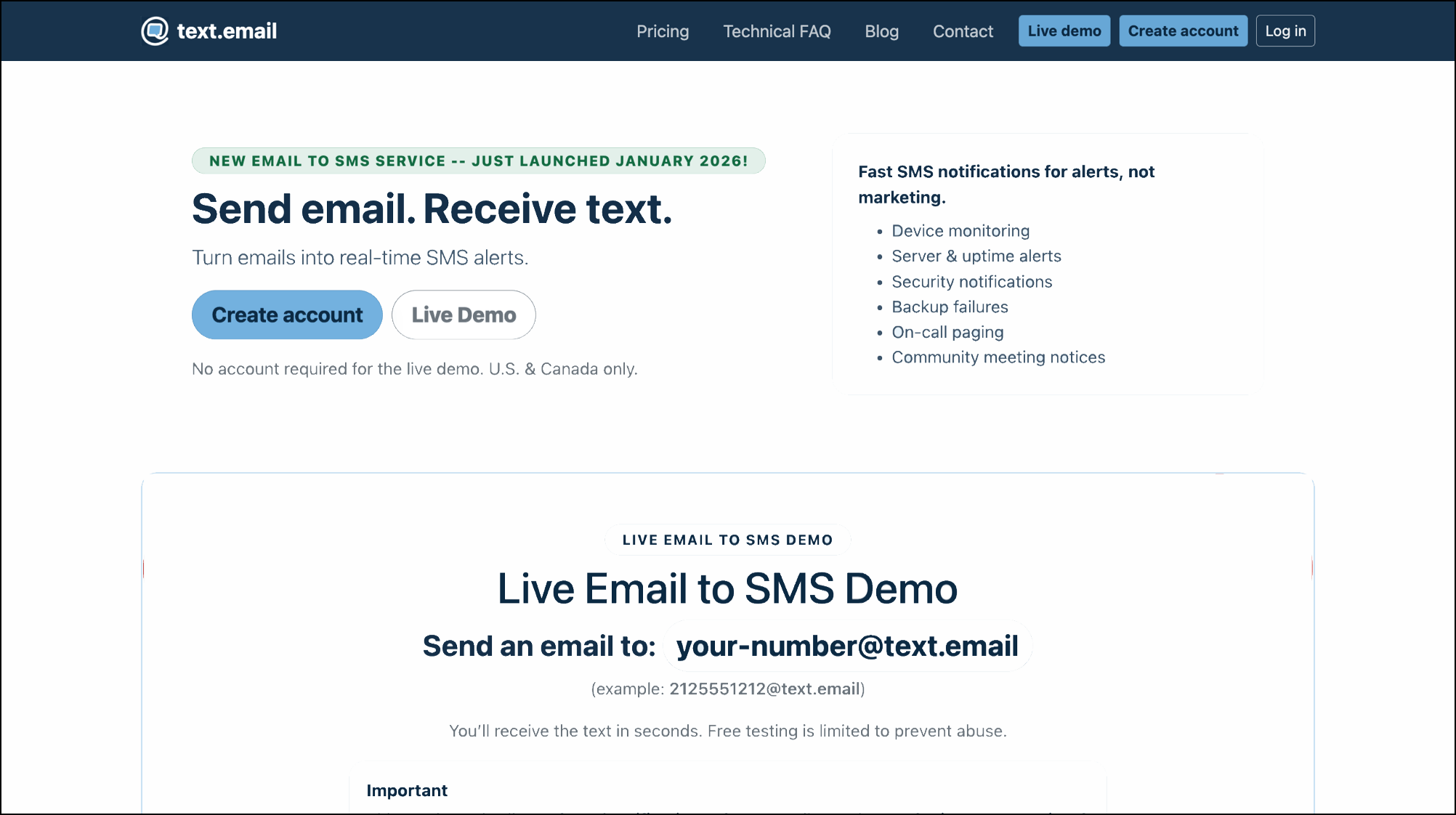
Of all the email to SMS options out there, text.email is the closest to being a drop-in replacement for what Verizon, AT&T, T-Mobile, and the rest of the cell phone carriers used to offer.
You sign up, get an email-to-text address, and it works immediately. Drop it into your systems and you’re good to go.
Pricing. $20/month or $200/year, both including 200 messages, then 5¢ each. There’s also a Low Use Plan at $30 for 100 messages, no subscription, and they don’t expire.
What sets it apart. You’ll be up and running in minutes. There’s no paperwork required. text.email also has quite a few features the carrier gateways didn’t have like team texting (with scheduled routing to who’s on duty), two-way messaging between text and email, required acknowledgement, and AI summaries to condense long emails into a single text.
Limits. text.email is made for alerting, not marketing or high-volume transactional use. U.S. and Canadian numbers only.
2. ClickSend – good for email-to-mass text

ClickSend isn’t a drop-in email-to-text service like some of the others on this list. It’s a mass texting platform, and one of its options for your mass texting is via email.
So if you want to do email-to-mass text, this is a good place to look. For the alerting you used to do with the carrier email to text? It’s a less-perfect fit.
Pricing. About 3 cents per SMS at the entry tier with the price going down as you buy more. It’s also roughly 0.42 cents per message in carrier fees and a dedicated number runs about $3.58 a month.
What sets it apart. There’s no subscription and inbound messages are free. Also, you can send mass texts, including marketing texts, via email.
Limits. I found that getting a U.S. number approved takes longer than their signup flow suggests, so don’t plan a same-day cutover.
3. TextBolt – good for two-way email to text customer comms
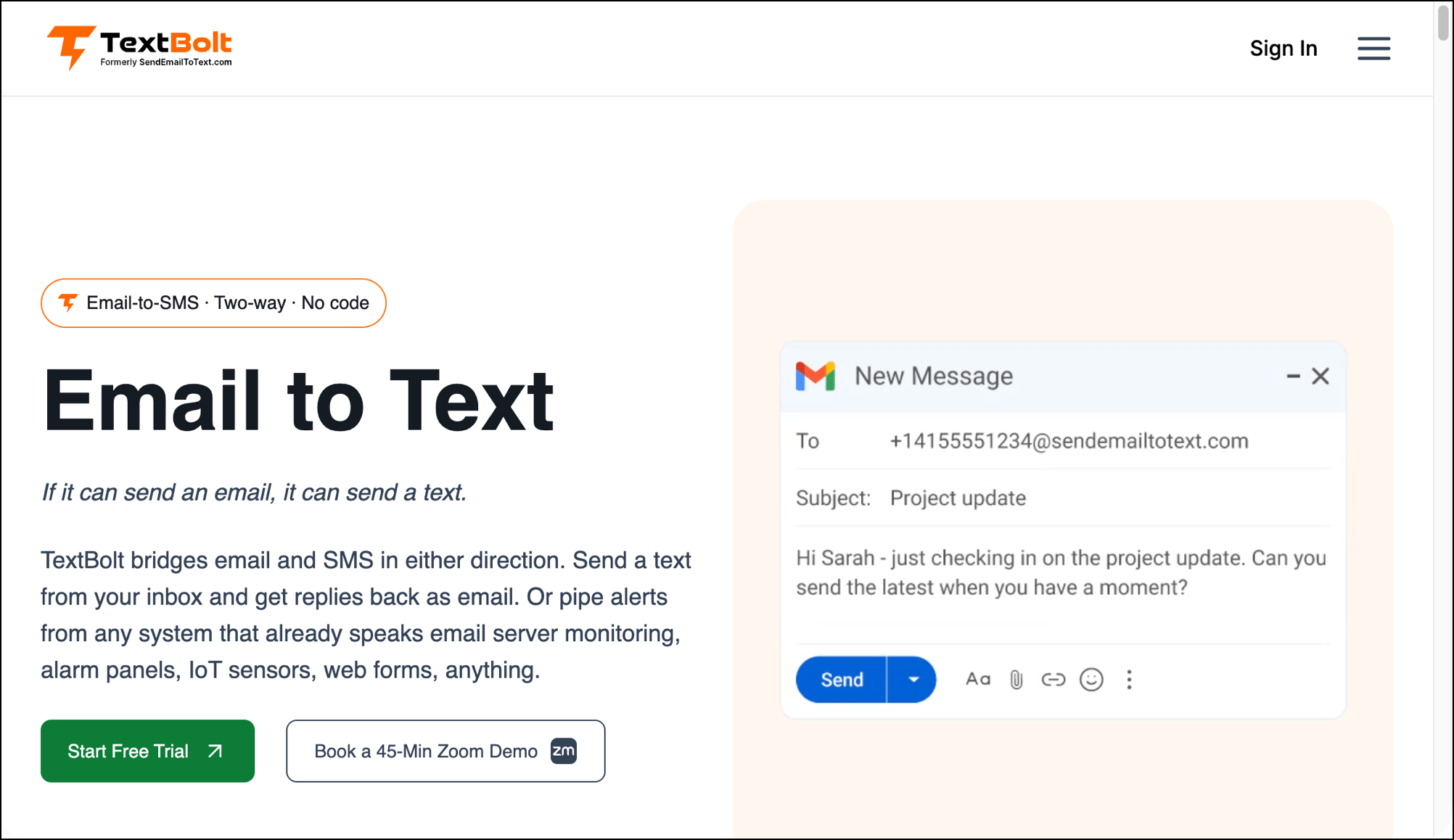
With TextBolt, you can send an email-to-text to any phone number. Replies to that text go back to that email. While a lot of other services offer this, TextBolt’s version is focused on using this feature for customer communications (e.g., support and even lead nurturing).
Pricing. $29 a month for 500 credits and a single user, $49 for 1,000 credits and up to a 10-person team, and $99 for 2,500. (One credit is, basically though not exactly, one standard text.)
A toll-free number is $45 a year on top of that if you want it; otherwise TextBolt handles 10DLC.
What sets it apart. TextBolt is really made for one-on-one email-to-text conversations. Again, while other services can do that, TextBolt is really meant to live inside Gmail or Outlook and not be an email address you drop into a monitoring system or use for team incident management.
Limits. U.S. and Canada only. Not made for mass texting or alerting, really made for one-on-one communications.
4. Textmagic – good for teams sharing an inbox
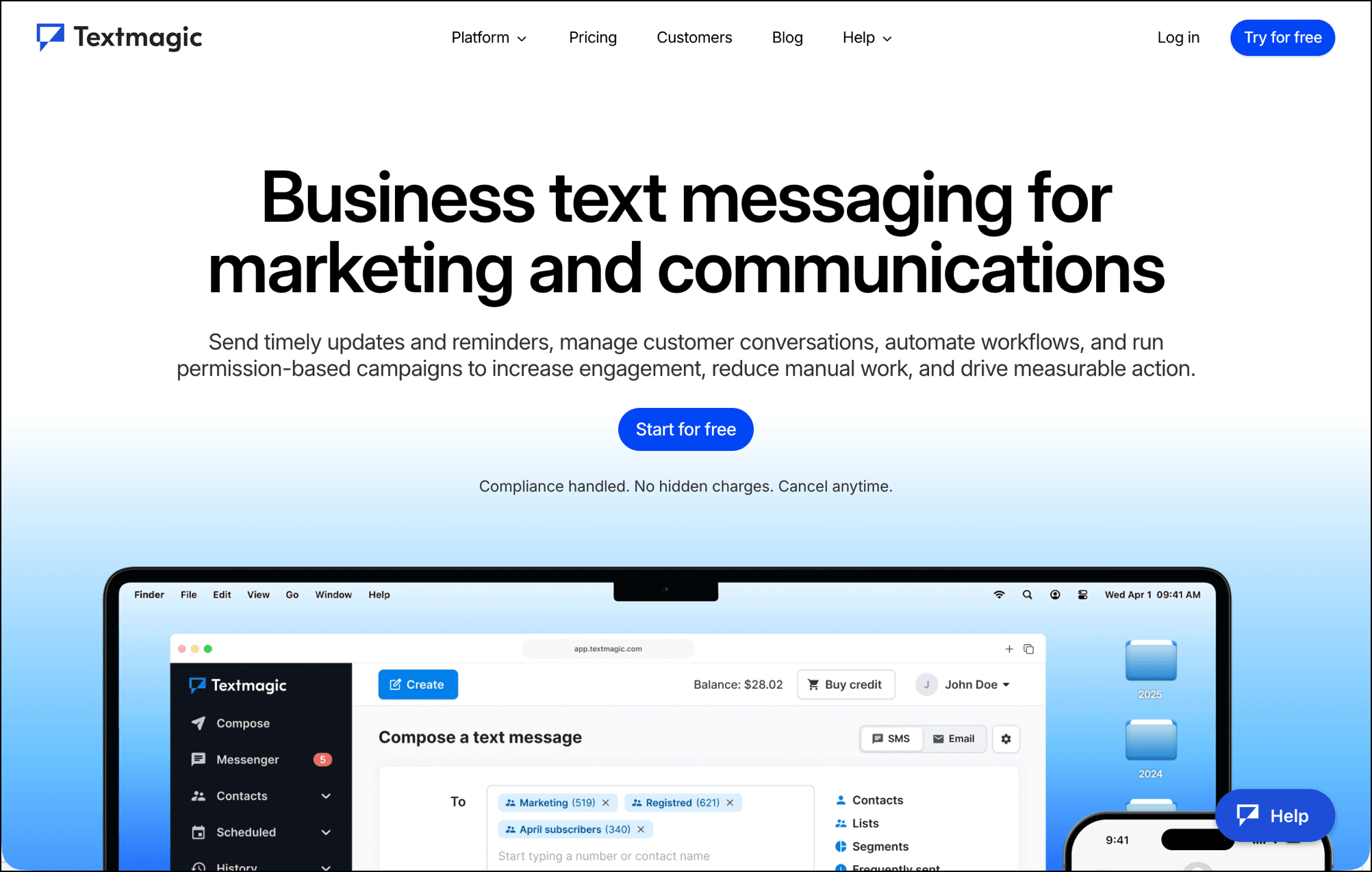
Textmagic sends texts from email like all the services on this list does (though, like some others, it’s mainly for marketing and comms blasts, not team alerting), but handles the replies different.
When any of your recipients reply, those messages come back to a shared inbox. Now anyone on your team can continue the conversation.
Pricing. About 4.9 cents per SMS, flat, no matter how much you send — though packages start at 500 messages (or $24.50). A dedicated virtual number is $10 a month. (And is mandatory in the U.S.) If you want to go through the 10DLC compliance process, you’ll pay for that and then another $10/month.
What sets it apart. The shared inbox. No, really, that’s what they orient their entire landing page around.
Limits. You can’t text internationally, that requires bringing your own phone number and system.
5. SMSGlobal – good for international email-to-text
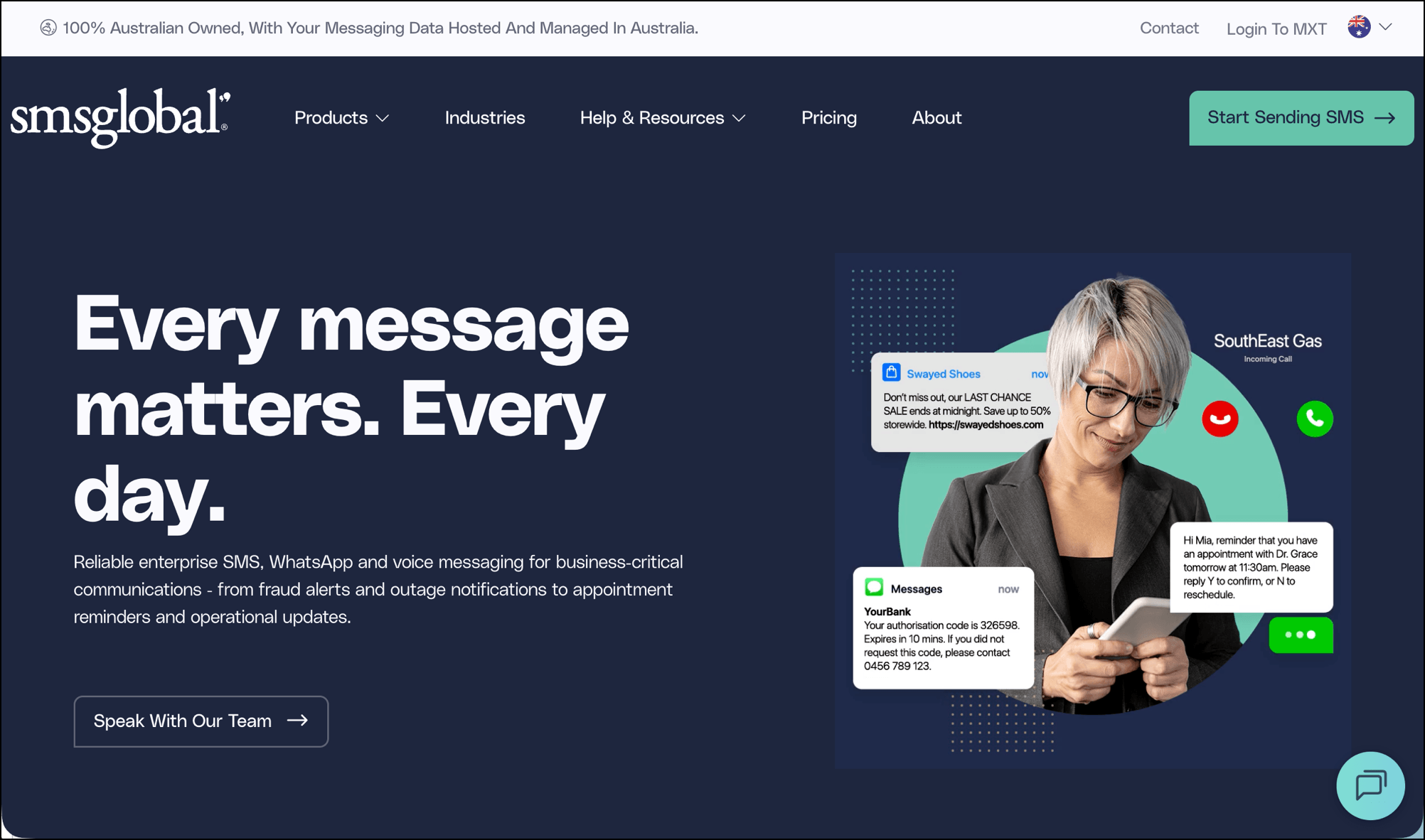
Every SMSGlobal plan includes email to SMS, though, yes, this is another bulk marketing platform rather than an alerting tool.
They connect straight to carriers across much of the world, so they reach phones most of this list can’t. Texting sure is way more complicated than emailing.
Pricing. The pricing is (more than a little) opaque and has changed since I tested the service, when it had monthly subscriptions. They say pricing is “as low as” 1.9 cents per message but that’s as much as they’re giving up. I do know it’s pay as you go now, not subscription based.
If you want to use a local number, SMS Global charges a $100 registration fee, then $40/month ongoing. So this is on the way high end of compliance pricing.
What sets it apart. The country list. Every country has its own rules when it comes to texting, and SMSGlobal actually handles more than 100 of ’em.
Limits. If you’re not planning to do a lot of international texting, there are more transparent and user-friendly options out there.
6. Notifyre – good for SMS and fax in one place
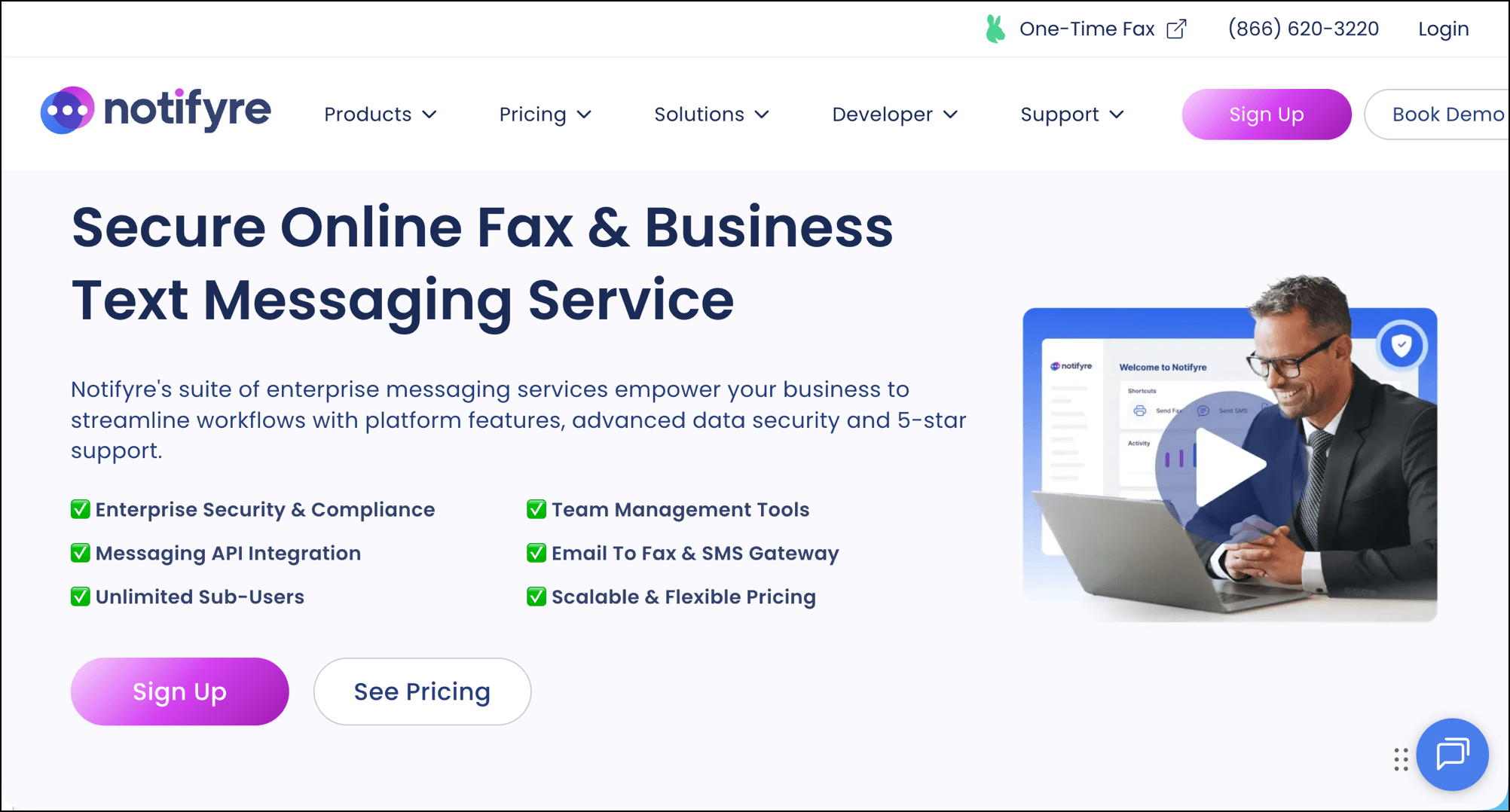
Notifyre is for businesses only — and I’m talking old school businesses, as it sends texts from emails and sends faxes from the same account. For healthcare, legal, and the other fields still running on fax, that’s useful consolidation.
Pricing. 2 cents per message part, with carrier fees already included. Inbound replies are free and your credits don’t expire. But… they mandate 10DLC, so getting set up to send starts at $60.90 and then there’s a monthly recurring cost of $16.40. So that 2 cents per message isn’t telling the whole story on cost.
What sets it apart. The fax side, plus ISO 27001 certification and HIPAA compliance, which together tell you exactly which customers they built this for (e.g., not you and your server alerts.)
Limits. You need an EIN to open an account, so an individual without one can’t sign up at all. And there’s a monthly charge for your number on top of the per-message rate, which at a handful of alerts a month is most of what you’re paying for.
7. PagerDuty – good if email to text is part of a larger team alerting system
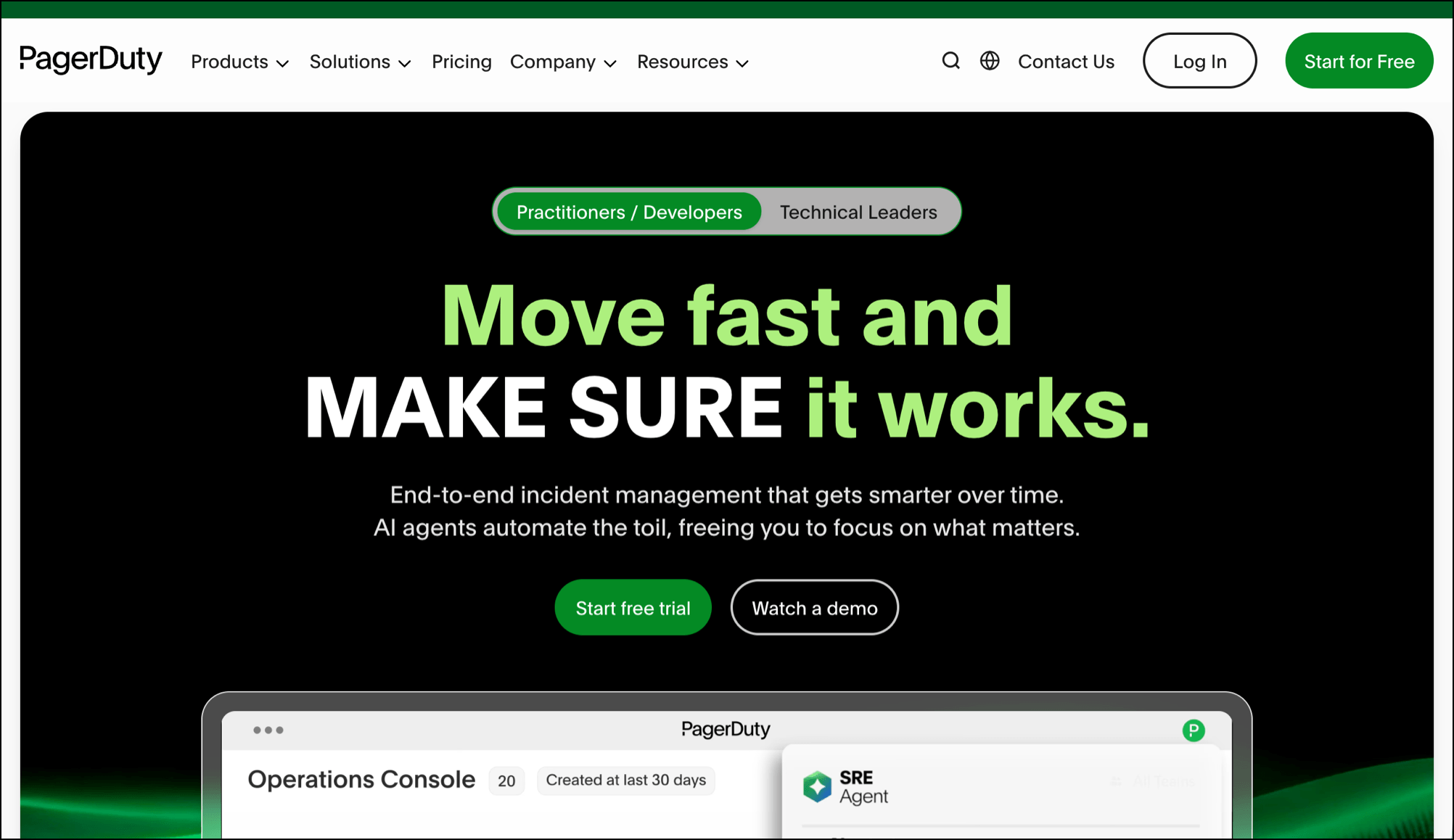
PagerDuty is a full-on alerting platform with email to text capabilities. You email an address and PagerDuty texts whoever’s on call. If that person doesn’t acknowledge it, the next person in the rotation gets texted, and so on.
Pricing. There’s a free plan for 100 messages a month and up to five users. Once you get out of that tier, the costs go up dramatically (the cheapest paid plan is $21/user/month).
What sets it apart. PagerDuty isn’t a replacement for the cell phone carriers’ defunct email to text. It’s a tool for on-call teams who need to know a server just went down and know who’s going to jump up to fix it.
Limits. If you need a full alerting platform, this works — if you don’t, it’s overkill (and probably too expensive to start integrating into your system).
8. Twilio – good if you just have to build your own system
We live in the “so maybe I’ll just fire up AI and build this myself” era.
Whether the economics make sense there aren’t really the point. The goal is the control.
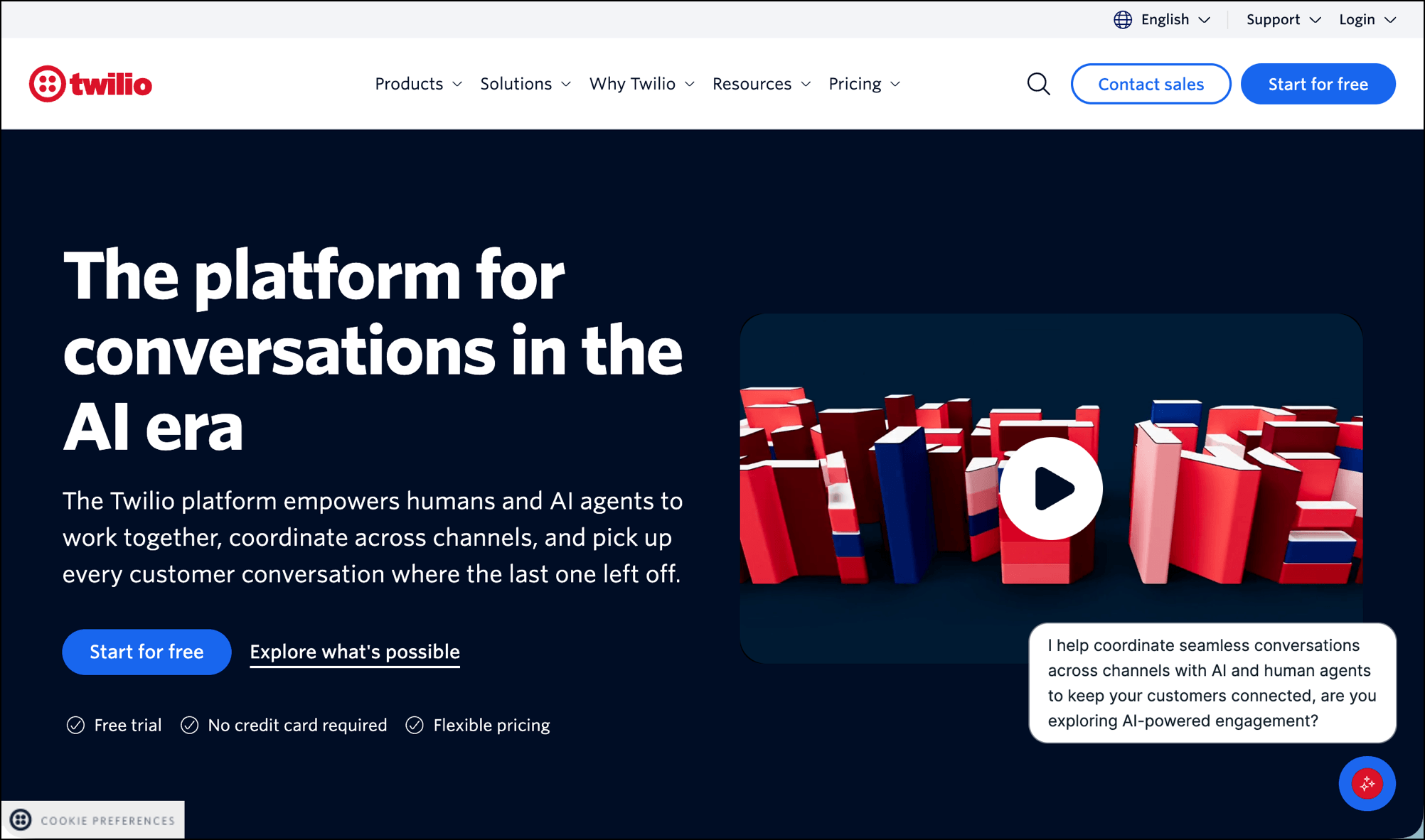
And if you’re going to go this route, it’s likely your first move will be enlisting Twilio to handle your texting infrastructure.
Pricing. Between messages and fees, it works out to around 1.2 cents per message. Plus $1.15 a month for the number (or $2.15/month for toll free). Figuring out 10DLC and any other regulatory work is on you.
There’s also a 0.1 cent cost for every message that fails.
What sets it apart. This is the do-it-yourself approach, not the done-for-you approach. If you’re building your own email to text system, you’ll use Twilio. If you aren’t building your own, you won’t.
Limits. Make no mistake: You’re signing up for a project, not a service. You won’t have this up and running in 15 minutes. You’ll have to deal with figuring out all the compliance work yourself. It’s another service that can silently break. (And how will you get the alert that that happened?)
9. SMSEagle – good if you want a hardware solution
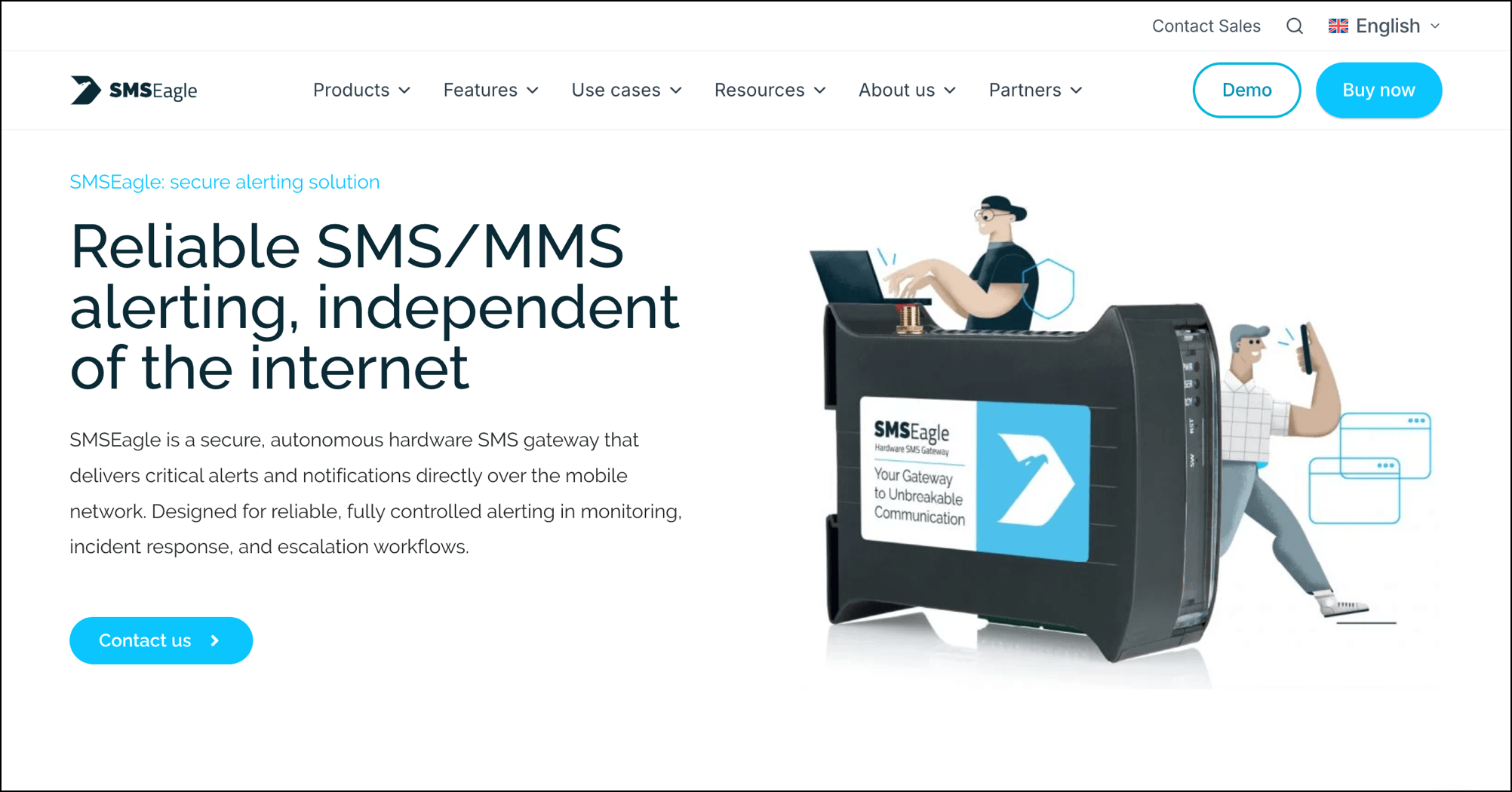
SMSEagle is here to answer the question: If the internet goes down, how are you going to get an alert that the internet went down?
That’s because SMSEagle is a hardware solution — the only one on this list. It takes email over SMTP and sends the text from a SIM card. There’s no cloud service involved anywhere, taking your internet service out of the equation.
Pricing. The prices aren’t published, but when I used this at a past company I remember it was at least $1,000 plus a monthly charge for cell service. So this is likely going to be the most expensive option on this list.
What sets it apart. This is a solution based on hardware and a SIM card. There’s a certain extra peace of mind that comes from that.
Limits. Hardware setups aren’t exactly quick and easy. And, of course, you do have to keep an eye on this to make sure it’s still working (especially if your alerts are infrequent).
Picking the Best Email to Text Provider in 2026
The cell phone carriers have all dropped email to text from your plan, but it’s still entirely possible to use email to get a text on your phone (or someone else’s phone).
We know this is something a lot of GMass users want (I even wrote a whole article a little while back on how to get text alerts when someone replies to your GMass campaign — and it uses one of the services from this list).
So the very short version is:
- If you want the closest thing to what the cell phone carriers’ email to text was like, but with even more features, go with text.email.
- If you want to build your own system and are willing to deal with the paperwork required, start with Twilio.
- If you’re looking to do email to mass texts, check out ClickSend.
And, of course, if you need an email solution, check out GMass. It transforms your Gmail/Google Workspace account into a mail merge and mass email platform.
You can try it for free — with no credit card required — and see why 400,000+ people rely on GMass and give it an average of 4.8 out of 5 stars across 12,000+ reviews.